

Q&A Series – Next Generation Leaders: Dake Kang
3rd June 2026
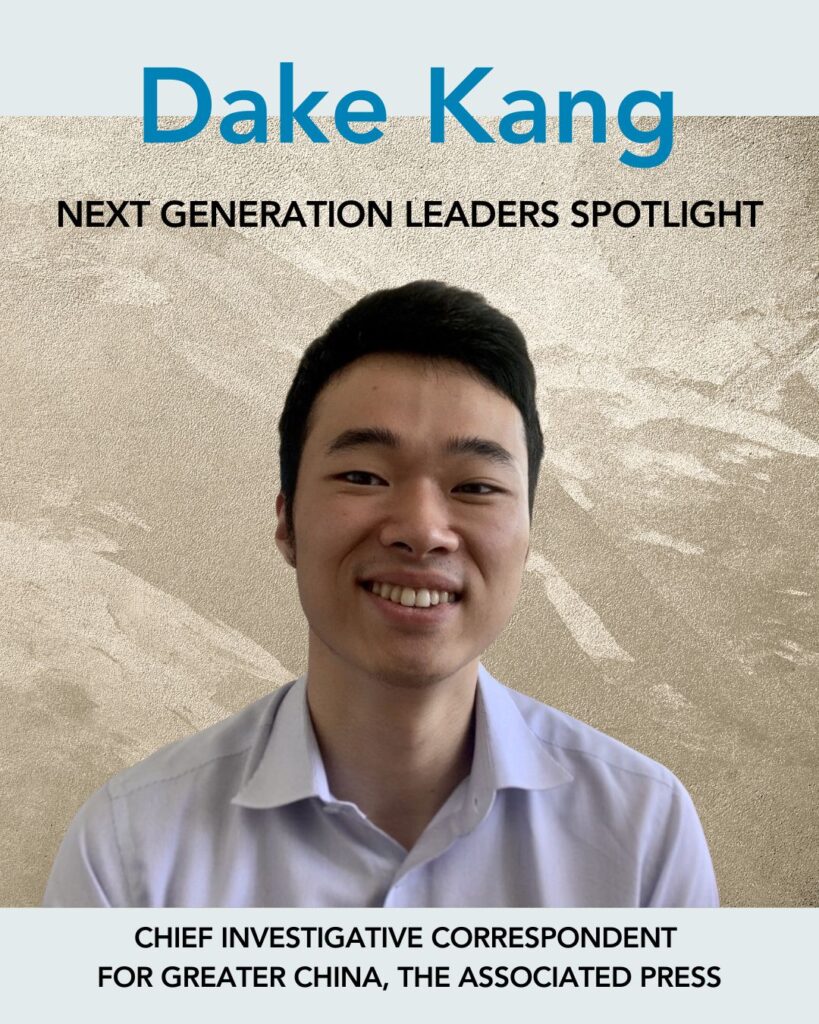
Dake Kang
Dake Kang is a video journalist and Chief Investigative Correspondent for Greater China, responsible for working with colleagues across the region on enterprise and long-term projects. With colleagues, Kang won the 2026 Pulitzer Prize in international reporting for a series on how Silicon Valley played a major role in designing and building China’s surveillance state, and has won numerous awards for coverage of technology, public health, and China’s border regions. Kang joined AP as an intern in Philadelphia in 2016 and has reported from New York, Thailand and Ohio.
Connect with Dake:
LinkedIn: https://www.linkedin.com/in/dakekang/
Twitter / X handle: @dakekang
Committee of 100: What inspired you to work in your professional field?
Dake: I studied history in college and have always loved thinking about the big questions about how we got where we are as a society. When I first encountered journalism as a profession, it was a revelation for me: you can do this for a living? There’s a cliché that journalists write the first draft of history, and for me it was a powerful draw.
China in particular was somewhere I had always wanted to return to. I’m Korean American, but spent five formative years as a kid in Shanghai and was totally enthralled by the city and the changes I saw taking place. In the early 2000s, it was magical: the energy, the optimism, the thrill of possibility. It felt like a city that was going places — vibrant and full of life, open and wild and free in a way I found really compelling. So when AP encouraged me to apply for a job opening in China, I leaped at the chance.
Of course, the world we’re living in now is very different from the early 2000s. I did a lot of growing up in the past eight and a half years in Beijing. But being a journalist in China is really a remarkable job and privilege, as you get to see Chinese society from top to bottom and roam this continent-sized country and grapple with all its complexity.
Committee of 100: What are some of the challenges you have encountered to become a leader in your respective field? Are Chinese Americans well-represented in your field, and what do you think are the reasons they are/aren’t well-represented?
Dake: Media in China is tightly controlled, and being a journalist in China is tricky in different ways depending on who you are.
If you’re white, for example, you’re treated as a total outsider, which has its pluses and minuses. The pluses are that people are very curious and will often be eager to engage with you, and will be forgiving if you don’t behave according to local traditions or culture. The minuses are that you might find yourself excluded from certain social situations no matter how hard you try to fit in, and you can find yourself on the receiving end of some nasty nationalism if you’re unlucky.
If you’re ethnically Chinese – Chinese American, for example – it’s a totally different ballgame. Expectations are much higher and more personal because you’re seen as being Chinese, which means if you write things seen as critical of the country or the state, you can be branded a traitor. The authorities tend to put more pressure on Chinese American journalists, and Chinese citizens are barred from being journalists for foreign media altogether. So it’s tough. At the same time, ethnic Chinese journalists can also face difficulties back in the West. They can face editors who don’t understand China well and insist on stripping nuance out of their stories, for example, or dismiss subjects they think unworthy of writing about. Or they can be targeted by politicians accusing them of being too close to the Chinese Communist Party in ways that can feel unfair and racially motivated.
As a result, Chinese and ethnic Chinese journalists face real difficulties and challenges that others don’t. Many burn out from being squeezed on both sides and have left China or China reporting. I think that’s a real shame.
I’m a bit of a unique case. I’m a Korean American who speaks better Chinese than Korean, and in many ways, I feel more at home in China than Korea. China is a vast, diverse country with a sizable ethnic Korean population, so I’m often treated almost like an honorary overseas Chinese person, not as a total foreigner. At the same time, I’m insulated from the pressures that ethnic Chinese journalists face here. So I’m quite privileged: I get to blend in as an insider, but I’m treated with a certain respect and distance that comes with being an outsider.
Committee of 100: What do you believe needs to be done so that more Chinese Americans feel empowered to follow and achieve their dreams?
Dake: Of course, as a Korean American, I am speaking from an outside perspective here and I want to be mindful of that, but as an Asian American, I can say this: the discourse on China tends to be quite polarized. For those of us working in this area, you’re often seen as a hawk or a panda hugger, with little space in between. I often see negative reporting about very serious issues in China attacked by those who want to promote China’s positive qualities, and likewise often see China’s very real accomplishments and achievements dismissed by people who are fixated on the bad things happening in China.
I think that’s a toxic attitude. The truth is this: all of these things are true at the same time – the good, the bad, and the ugly. No one person’s story or experience should be dismissed or invalidated because it clashes with the narrative of another.
I think it behooves our community to be aware of and understand the complexities of being caught between the U.S. and China, two global powers locked in a tense, intricate dance and struggle with each other. In journalism, in politics, in diplomacy, I think Chinese Americans often face questions about their loyalties and identities, and I think it would benefit everyone if we understand that the rich, varied experiences of being in both worlds ultimately benefit everyone. Both countries stand to learn a lot from each other – both as a model, and as a warning, perhaps, of what not to do. Chinese Americans should be able to embrace their heritage and their experiences without being vilified.
Committee of 100: How can your NGL community support you and your work? Do you have any recent or upcoming projects you’d like to highlight?
Dake: My NGL community has been very supportive. One of the best things about the program has been getting to meet outstanding people in fields very different from mine, and I’ve learned lots from their perspectives. As a journalist, we have to stay curious and listen to a wide variety of experiences and perspectives, and I’m grateful that so many in my cohort have been so warm and willing to bring me into their worlds.
Committee of 100: For those who just recently graduated college or are early in their careers, what advice would you give to them?
Dake: Stay curious, stay genuine, and stay true to yourself. Follow your gut. Stay in touch with your emotions. If you feel like you’re being pressured into doing something you don’t want to, you probably are. If you feel like you’re betraying your dreams or your values, you probably are. People can sniff out insincerity with shocking accuracy; they can tell you’re faking it, and you won’t end up going very far. Conversely, if you’re genuine, sincere, and act with integrity, people will respect it. Even if it’s scary or if you encounter obstacles in the short run, naturally, over time, you’ll find that you’re doing the things you want to do and getting to know the people you should know.