

Q&A Series – Next Generation Leaders: Joshua Liao
4th August 2026
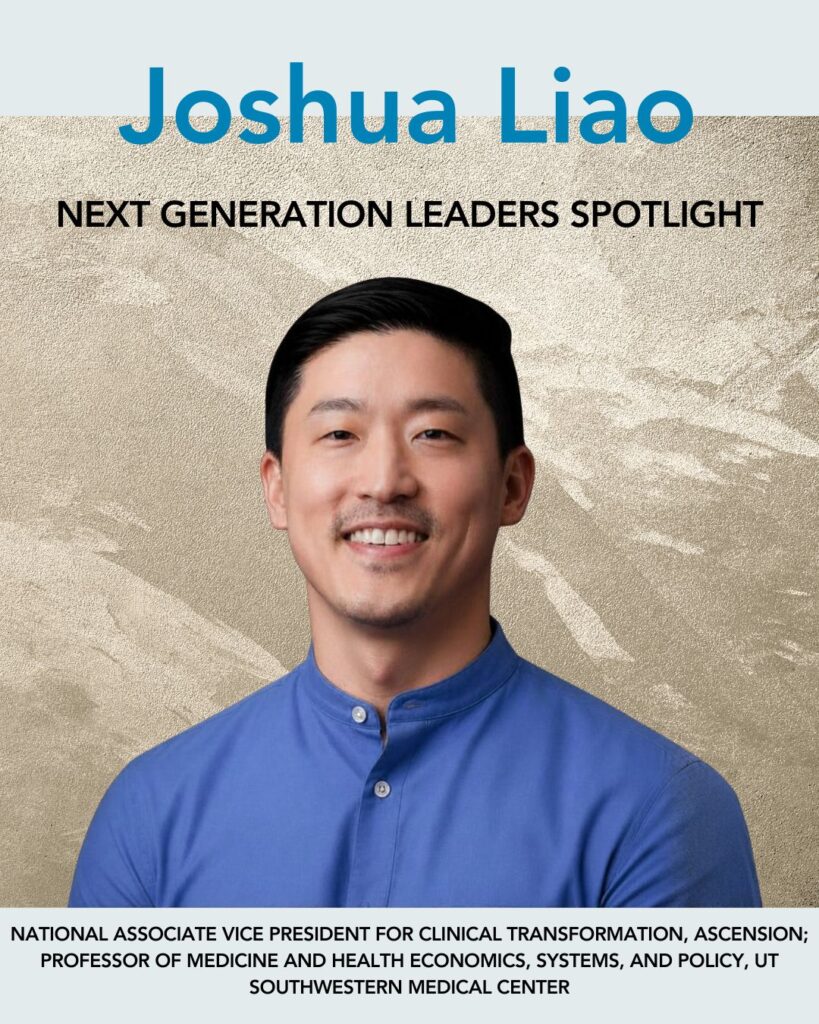
Joshua Liao
National Associate Vice President for Clinical Transformation, Ascension; Professor of Medicine and Health Economics, Systems, and Policy, UT Southwestern Medical Center
Joshua M. Liao, MD, MSc, FACP, FRCP, is a physician executive, national policy leader, and health systems scholar committed to improving health by strengthening the systems through which care is financed and delivered. As National Associate Vice President for Clinical Transformation at Ascension, he leads enterprise strategy and execution for technology-enabled approaches to engaging patients and clinicians, including remote patient monitoring, patient-reported outcomes, clinical decision support, and large-scale engagement initiatives. He is also a Professor of Medicine and Health Economics, Systems, and Policy at UT Southwestern Medical Center and serves on national bodies that advise Congress and federal health officials on Medicare policy and physician-focused payment models.
Previously, Dr. Liao served as Associate Chair for Health Systems in the Department of Medicine and as an enterprise medical director at the University of Washington, where he helped lead system-wide strategy related to value-based care, payment, and contracting. He founded a nationally recognized policy evaluation unit that became the formal evaluation partner for the Washington Health Care Authority and led evaluations focused on areas such as primary care delivery and telemedicine.
His prior roles at UT Southwestern have included Division Chief of General Internal Medicine, holder of the Walter Family Distinguished Chair in Internal Medicine, Director of Research Methods for the institution’s Clinical and Translational Science Award, and founder and executive lead of the Clinical Research, Evaluation, and Data Office. His scholarship has focused on how health care financing and delivery can work together to improve outcomes for patients and communities.
Connect with Joshua:
LinkedIn: https://www.linkedin.com/in/joshualiao/
Committee of 100: What inspired you to work in your professional field?
Joshua: I was drawn to medicine because it brings together science, human experience, and the opportunity to make a tangible difference in someone’s life. Over time, however, I came to see that what happens between a physician and a patient is profoundly shaped by the larger system surrounding them—how care is organized, financed, measured, and improved. That realization led me toward health systems work.
I have tried to build a career at the intersection of clinical care, policy, research, and organizational leadership because many of health care’s hardest problems cannot be solved from within any one of those areas alone. I am inspired by the opportunity to translate ideas across those boundaries and create systems that make it easier for patients to receive good care and for clinicians to provide it.
More broadly, I believe in living and working by design rather than simply accepting the default path. The right career is not necessarily the one with the most prestigious title or the most conventional trajectory. It is the one that allows you to use your abilities in service of problems that matter while continuing to grow as a person.
Committee of 100: What are some of the challenges you have encountered to become a leader in your respective field? Are Chinese Americans well-represented in your field, and what do you think are the reasons they are/aren’t well-represented?
Joshua: One of the greatest challenges has been learning to work across several different worlds. Clinical medicine, research, public policy, technology, and health system operations each have their own language, incentives, and definitions of success. In my work, leadership has often meant translating among them, building trust among people with different perspectives, and making responsible decisions under time pressure and with incomplete information.
Another challenge is learning and living out the reality that excellent work and leading are related, but they are not the same. Leadership requires developing a point of view, communicating it clearly, taking responsibility for difficult choices, and creating the conditions for other people to succeed. It also requires being willing to step into visible roles before you feel completely ready.
Chinese Americans are well represented in many clinical, scientific, and technical areas of health care, but that representation much less commonly extends into the most senior executive, governance, and policymaking roles. There are likely many reasons for this, including limited access to sponsorship, relatively fewer visible role models, and cultural norms that may place greater emphasis on humility, reliability, and technical achievement than on self-advocacy or public leadership. Those qualities can be strengths, but they can also prevent Chinese Americans from stepping forward to lead.
Committee of 100: What do you believe needs to be done so that more Chinese Americans feel empowered to follow and achieve their dreams?
Joshua: Empowerment requires more than telling people to be confident. People need examples of what is possible, access to meaningful opportunities, honest guidance, and communities that will support them when they take risks.
I believe earlier in their careers, Chinese Americans would benefit from being exposed to a wider range of possible lives and careers, including paths that don’t follow the most traditional definitions of achievement. It’s easy to say that a successful life is not measured only by income, credentials, or professional status, but it is also easy to lose sight of this in practice. In truth, success also includes control over one’s time, strong relationships, physical and mental well-being, continued growth, and a sense of purpose.
I also think that within the community, we need both high expectations and high support. We can communicate our belief in what people are capable of while also providing the introductions, candid feedback, sponsorship, and practical help they need to reach that potential. In my experience, high expectations without support can become pressurewhile support without expectations can unintentionally inhibit growth. The combination is what helps people expand their sense of possibility.
Finally, I think we would benefit from encouraging Chines Americans to ask not only, “What am I supposed to do?” but also, “What kind of life am I trying to build, and what choices will move me in that direction?” Better questions are more valuable than quick answers, and the latter are better questions.
Committee of 100: How can your NGL community support you and your work? Do you have any recent or upcoming projects you’d like to highlight?
Joshua: The NGL community can support my work by continuing to create connections among people working across health care delivery, technology, public policy, research, and community leadership. Many of the most important health care problems require collaboration across traditional professional and organizational boundaries. I’m interested in exchanging ideas with people working to make care more accessible, equitable, evidence-based, and responsive to the needs of patients and communities.
A recent project to highlight is my book, Reshaping Health Systems: What Drives Health Care and How You Can Change It. The book follows the journeys of a patient and a clinician to explain how health systems influence care and how people can use tools from fields such as quality improvement, design thinking, change management, and implementation science to improve those systems. The book supports my broader goal of making health systems knowledge practical and accessible so that more people in health care feel equipped to change the environments in which they work.
Committee of 100: For those who just recently graduated college or are early in their careers, what advice would you give to them?
Joshua: I’m not sure I have advice, per se, but I have held on to several lessons from earlier in my career.
First, I benefited greatly from seeking out mentors, leaders, and collaborators who offered both high expectations and high support. The best mentors and role models were those who saw more potential in me than I may initially have seen in myself, while also telling me honestly what I needed to improve.
Second, I tried to focus less on identifying a perfect destination and more on choosing a meaningful direction. From mentors, I learned that careers rarely unfold according to a completely clean plan, and that there’s a lot of value in seeking environments where you can learn quickly, work with people of integrity, solve real problems, and develop skills that will remain useful as your interests evolve.
Third, I worked on creating value before worrying too much about receiving recognition for it. It helped me to concentrate first and foremost on becoming someone who understands problems deeply, follows through consistently, and makes the people around me better.
Fourth, as I created value over time, I came to recognize that good work will not always speak for itself. I needed to learn how to communicate what I cared about, ask for opportunities, and build genuine relationships before I needed them.
Fifth, with varying degrees of success, I learned not to sacrifice other important parts of life in pursuit of one narrow definition of achievement. For most of us, life includes seasons when work demands more of our attention, and perfect daily balance is unrealistic. But I found it helpful to remember that, even during an intense professional period, it was important to continue making small investments in the parts of my life I wanted to preserve. It may sound simple, but it’s true: anything above zero can compound.
Finally, I tried to view time not simply as a resource to exchange for future success, but as part of success itself. Working hard and pursuing meaningful goals have always been important to me, but I was fortunate to realize that paying attention to the people and seemingly ordinary moments that make life meaningful is equally important. I am grateful to the mentors and role models who helped me understand that too much focus on reaching the next milestone can cause us to overlook the life unfolding along the way.