

Q&A Series – Next Generation Leaders: Emma Zang
5th May 2026
Emma Zang
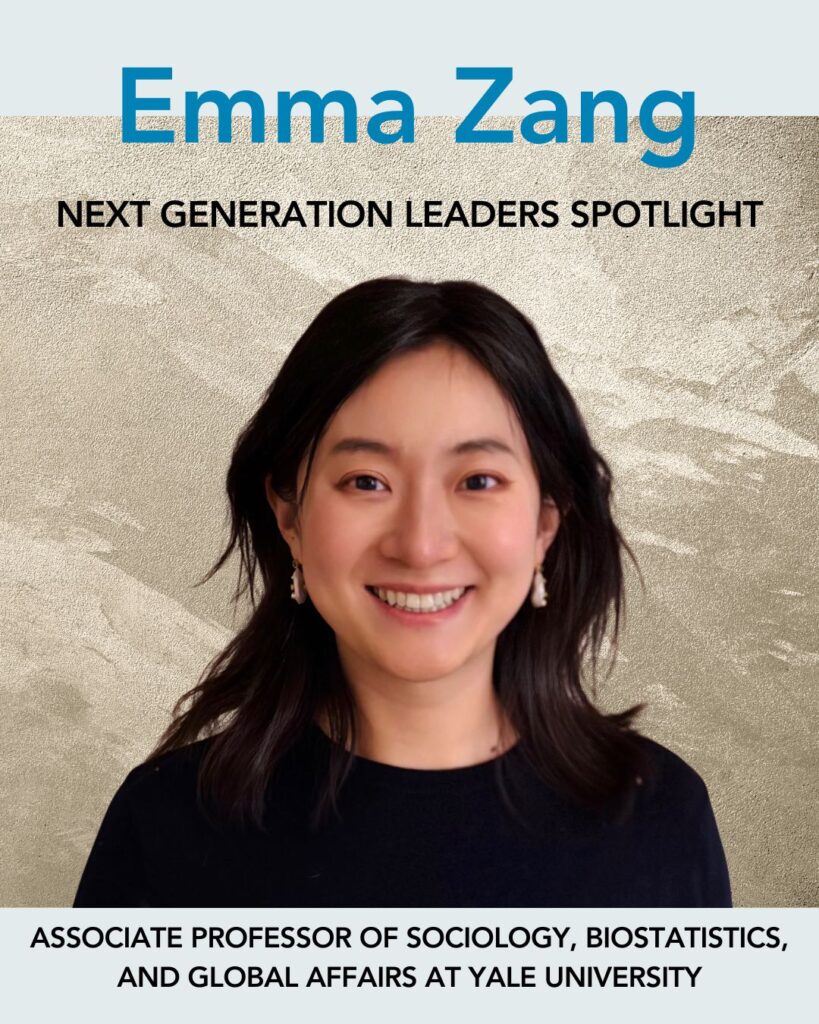
Emma Zang is an Associate Professor of Sociology at Yale University, with secondary appointments in Biostatistics and Global Affairs. A demographer by training, her research examines how inequality unfolds across the life course, with a focus on health, family, and social policy. Her work integrates large-scale data with advanced quantitative and computational methods, including recent applications of AI to social science questions. She directs an interdisciplinary research lab at Yale and co-organizes major convenings at the intersection of AI and social science. Her research has appeared in leading journals such as the American Journal of Sociology, Demography, JAMA Internal Medicine, and Psychological Methods, and has been featured in outlets including CNN, NBC, and The Washington Post.
Emma earned her Ph.D. in Public Policy (2019) and M.A. in Economics (2017) from Duke University. She also holds training in law and sociology from China and completed graduate study in social science at the Hong Kong University of Science and Technology. Her interdisciplinary background informs a research agenda that bridges demography, economics, and public health. Her work has been supported by the National Institutes of Health and other competitive funding sources, and she has held visiting appointments at leading research institutions.
Connect with Emma:
LinkedIn: https://www.linkedin.com/in/emma-zang-72245436/
Twitter / X handle: @DrEmmaZang
Committee of 100: What inspired you to work in your professional field?
Emma: I started out as a law student in China, and I expected to become a lawyer. What changed my direction was divorce, specifically the gap between how divorce looked in the statute book and how it played out in real women’s lives. On paper, the law treated husbands and wives as equals. In practice, women had a much harder time leaving, and often walked away with much less. I kept asking my professors why, and the legal answers never satisfied me. The more honest answers lived in sociology: in gender norms, in family expectations, in how institutions quietly encode whose interests count.
That realization has basically been the through-line of my career. The interesting question was never what the rule said. It was what the rule did. I picked up economics and statistics at HKUST and then at Duke because I wanted tools sharp enough to answer those questions at scale. I became a demographer because demography takes the long view. It looks at how small differences in early life compound into very different lives decades later. I still find it a little uncanny how predictable some of those patterns are. A lot of what we think of as personal choice turns out, in the aggregate, to be remarkably structured.
Committee of 100: What are some of the challenges you have encountered to become a leader in your respective field? Are Chinese Americans well-represented in your field, and what do you think are the reasons they are/aren’t well-represented?
Emma: The hardest challenges have been the ones you can’t point to. No one tells you that in American academia, credit tends to accrue to whoever speaks fastest and most confidently in the seminar. Promise is often read through cues like voice, posture, and willingness to interrupt, which have very little to do with how good your ideas actually are. I was trained in a culture that treats modesty as a virtue and listening as a skill. It took me a long time to accept that in this system, if you don’t claim your own work, it will be quietly absorbed into someone else’s story of the field.
On representation: Chinese Americans are visible in the quantitative wings of the social sciences, and that visibility sometimes obscures how narrow the presence actually is. We are much less represented in qualitative sociology, in theory, in the parts of the discipline that shape public discourse, and in senior leadership such as chairs, deans, and society presidents. I think the deeper pattern is this. We have been channeled into the roles where the rules are legible, where there are clear metrics, technical mastery, and measurable output. We have been under-channeled into the roles where power is exercised through less legible means. That is no accident. Fields that reward formal credentials are easier to enter from the outside. Fields that run on networks and taste are harder. The long-term question is which rooms we are in, not just how many of us are in the room.
Committee of 100: What do you believe needs to be done so that more Chinese Americans feel empowered to follow and achieve their dreams?
Emma: I want to be honest about a tension in this question. The standard answer is “follow your dreams,” but dreams don’t form in a vacuum. They’re shaped by what you see people like you doing, and by what your family rewards you for. When the visible script is narrow, doctor, lawyer, engineer, finance, a lot of kids don’t dream outside it. They’re capable of more, but nothing in their environment told them those other lives were real options. So the first thing we need to do is widen the script. Not by giving pep talks, by making unconventional paths visible and legitimate.
The second thing is more uncomfortable. A lot of our community conversation focuses on overcoming discrimination from outside, including the bamboo ceiling, the model-minority trap, and geopolitical suspicion. All of that is real. Some of the most powerful constraints, though, come from inside: the intense focus on prestigious credentials, the discomfort with risk, the tendency to treat doing well and doing good as a zero-sum trade. Empowerment, if it means anything, has to include permission to disappoint. Permission to choose a less prestigious path, to fail publicly, to take the years off. Those are the things our parents couldn’t afford. One of the real marks of having arrived is being willing to spend some of that privilege on the risks they couldn’t take.
Committee of 100: How can your NGL community support you and your work? Do you have any recent or upcoming projects you’d like to highlight?
Emma: The most useful thing NGL can offer me is something academic life is bad at producing: sharp people outside my own discipline. A lot of what I study, including remote work, fertility, caregiving, and AI in social science, is being shaped right now by decisions inside companies, governments, and foundations. I’d love more direct contact with people making those decisions. The research gets better when it’s in conversation with reality, and honestly, so does reality when it’s in conversation with research.
Three projects I’m excited about. First, I’m finishing a study using Nordic register data on how the rise of telework is reshaping fertility, a question that sits right at the center of the aging-society problem every rich country is about to confront. Second, I’m writing a Perspective piece on remote work and mental health that pushes back on some of the simpler narratives in that debate. Third, I’m co-organizing the Yale AI Social Science Conference, which aims to move this emerging field past demo-driven hype and toward real methodological standards for how AI should, and shouldn’t, be used to study human behavior. Introductions, collaborators, and honest critics are all welcome.
Committee of 100: For those who just recently graduated college or are early in their careers, what advice would you give to them?
Emma: One piece of advice, and it goes against a lot of what you’ll be told: optimize for interestingness over optionality. My generation was trained to accumulate options, including the right school, the right firm, the right two-year program, on the theory that options compound. They don’t, not really. What actually compounds is depth. Ten years of genuinely caring about a problem puts you somewhere very few people ever reach. Ten years of collecting credentials puts you in a crowded room with everyone else who did the same thing.
Two practical corollaries. First, take a hard skill and go deep. Statistics, writing, a language, a craft. Early in your career you’ll be tempted to stay broad because it feels safer. It isn’t; it just feels that way. Second, take your relationships as seriously as your résumé. Careers are built out of a surprisingly small number of people who vouched for you at the right moment, and you don’t get those by networking. You get them by actually reading a friend’s draft, showing up to a colleague’s talk, and sending the introduction when it costs you something.
And finally, pay attention to what you’re like on your best days. Notice what you’re like when you lose track of time and come out of the work more alive than when you started. That signal is quiet in your twenties and gets harder to hear the more successful you become. Protect it. Almost everything good in my own career came from trusting it, even when it pointed somewhere unfashionable.