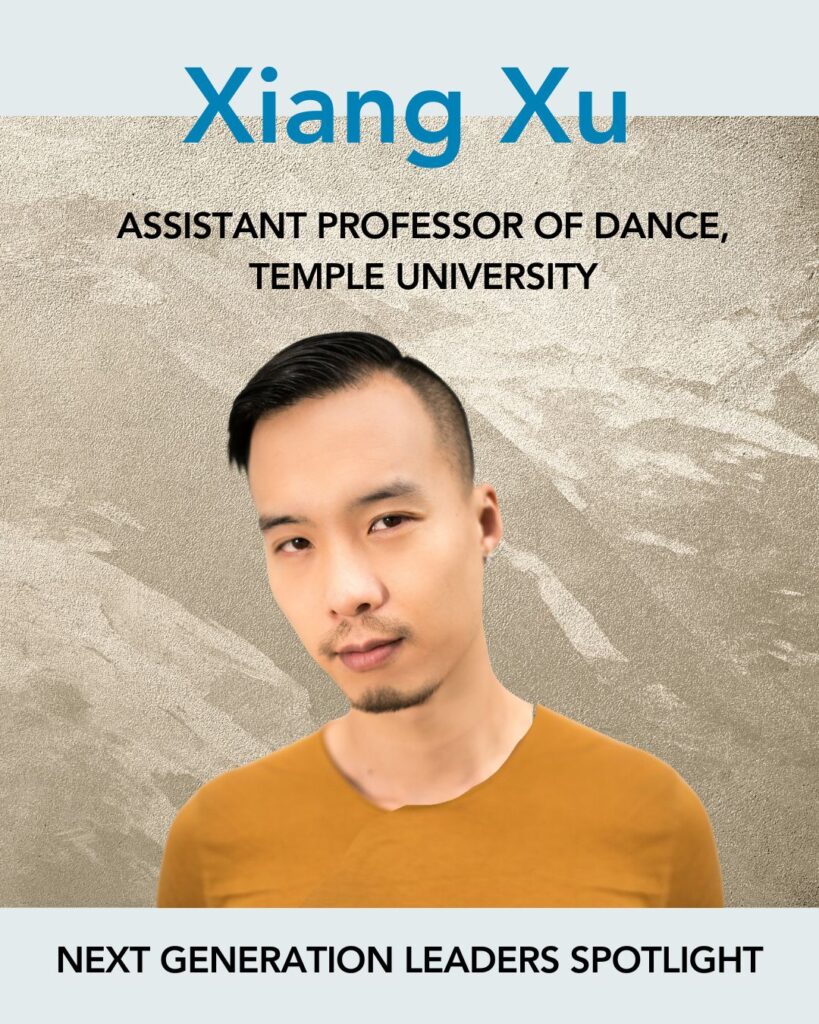
Xiang Xu
Xiang Xu is an Assistant Professor of Dance at Temple University’s Department of Dance in the United States, where he teaches technique, repertory, and composition while contributing to curriculum development and international initiatives. Based between Philadelphia and New York City, he is an internationally active choreographer, performer, and educator whose work bridges Asian bodily aesthetics and Western contemporary dance practices. Xu is the founder and artistic director of Xiang Xu Dance and the creator of Sino-Contemporary Dance Technique, a training system grounded in Chinese classical dance, martial arts, and contemporary movement research. His professional activities include choreography, performance, research, and global collaborations with dance institutions and companies across the U.S., Europe, and Asia, alongside ongoing scholarly and artistic engagement in redefining contemporary dance pedagogy through an Asian embodied lens.
Xiang Xu’s past professional experience spans international academic teaching, choreographic residencies, and performance engagements across the United States, Europe, Asia, and the Middle East. Prior to his current appointment, he served as Adjunct Faculty at Syracuse University and as a Guest Artist at Santa Monica College, teaching contemporary dance, ballet, composition, and improvisation. His career includes extensive teaching residencies and workshops at institutions such as the Beijing Dance Academy, Inner Mongolia Arts University, Northwest Normal University, Shouze Arts Center, Shandong Opera and Dance Theatre, Tangfeng Dance Company (Taiwan), and the Shaolin Epo Martial Arts School, where he also conducted movement research as a visiting scholar. As a choreographer, Xu has been commissioned by major universities, festivals, and dance companies worldwide, including the Joffrey Academy of Dance, Boris Eifman Dance Academy, Dance Canvas, Cambodian National Arts Center, Palestinian Diyar Theatre, and Drexel University. His performance experience includes appearances with the Merce Cunningham Trust and presentations at venues such as UCLA Royce Hall, The Broad Stage, and major international festivals, reflecting a career deeply rooted in cross-cultural practice, research-driven choreography, and global artistic exchange.
Xiang’s Dance Website: https://www.xiangxudance.org
Connect with Xiang on LinkedIn: https://www.linkedin.com/in/xiangxudance/
Connect with Xiang on Instagram: https://www.instagram.com/xiangxudance/
Committee of 100: What inspired you to work in your professional field?
Xiang: I was drawn to dance at a very young age, not only because of the physical beauty of movement, but because I felt it was a way to think, feel, and understand the world through the body. Growing up in China and training at Beijing Dance Academy, I was deeply immersed in traditional Chinese dance aesthetics and philosophies. Later, when I encountered Western modern and contemporary dance in the United States, I became fascinated by the contrast—and the gap—between these movement systems. I wanted to understand how different cultures think through the body, and how dance could become a space for dialogue rather than replacement. That curiosity eventually shaped my path as a choreographer, educator, and researcher, and led me to dedicate my career to bridging Asian bodily traditions with contemporary dance practices.
Committee of 100: What are some of the challenges you have encountered to become a leader in your respective field? Are Chinese Americans well-represented in your field, and what do you think are the reasons they are/aren’t well-represented?
Xiang: One of the biggest challenges I’ve faced is navigating a field where leadership, authorship, and innovation are still often defined through Western frameworks. As a Chinese immigrant artist, I’ve sometimes felt pressure to either assimilate into dominant aesthetics or to be positioned as “culturally specific” rather than universally relevant. Chinese Americans are still underrepresented in leadership roles within contemporary dance, especially in academia and major institutions. I think this comes from a combination of factors: historical lack of access, immigration barriers, cultural expectations that discourage risk-taking in the arts, and the ongoing invisibility of Asian bodies as creative leaders rather than technicians. Becoming a leader has meant insisting that my embodied knowledge, cultural background, and artistic questions are not peripheral, but essential to how contemporary dance evolves.
Committee of 100: What do you believe needs to be done so that more Chinese Americans feel empowered to follow and achieve their dreams?
Xiang: I believe empowerment starts with visibility and validation. Chinese Americans need to see people who look like them occupying leadership roles and defining the field, not just participating in it. Mentorship is critical—especially mentorship that understands cultural nuance, immigration experience, and the emotional labor of navigating multiple identities. Institutions also need to expand their definition of excellence to include diverse cultural knowledge systems, rather than expecting artists to conform to a single dominant narrative. On a personal level, I think it’s important for Chinese Americans to trust their instincts, honor their backgrounds, and believe that their stories and bodies carry value. Following one’s dream often requires unlearning fear and permission-seeking, and learning to claim space with confidence.
Committee of 100: If applicable, how can your NGL community support you and your work? Do you have any recent or upcoming projects you’d like to highlight?
Xiang: The NGL community has been incredibly meaningful to me because it creates a space where leadership is not separated from identity or values. Support from the community can come through dialogue, collaboration, visibility, and shared advocacy—especially in amplifying Asian American voices in the arts and education. In terms of projects, I am currently developing and expanding Sino-Contemporary Dance Technique, a training system rooted in Chinese classical dance, martial arts, and contemporary movement research. I’m also engaged in international teaching residencies and choreographic projects across Asia, Europe, and the U.S., as well as new creative works that explore embodiment, migration, and human connection. Continued support helps sustain this work and allows it to reach broader communities.
Committee of 100: For those who just recently graduated college or are early in their careers, what advice would you give to them?
Xiang: I would tell them to be patient with themselves and to trust that growth takes time. Early in your career, it’s easy to measure success by external recognition, but what truly sustains you is clarity of purpose and commitment to your craft. Stay curious, keep learning, and don’t be afraid to change direction as you gain new insights. Seek mentors, but also learn to listen to your own voice. Most importantly, don’t minimize who you are to fit into existing systems—your background, perspective, and lived experience are not obstacles, they are sources of strength. Leadership often begins long before a title appears.