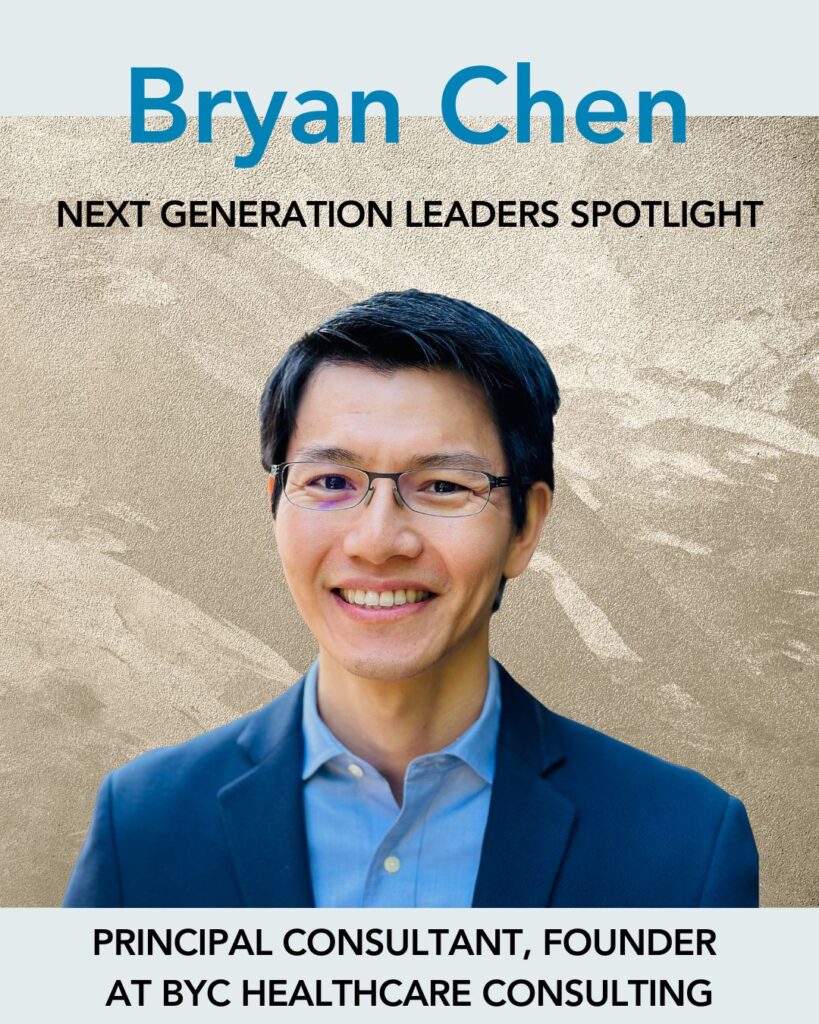
Bryan Chen
As the founder and principal consultant at BYC Healthcare Consulting, Bryan works with digital health companies and investors on strategic topics including go-to-market, growth, and product. In addition, he serves as a mentor for the Center for Life Science Ventures at Cornell University and is an advisor to an early-stage stealth startup. In addition to his professional roles, he actively contributes to Asian American issues such as increasing political engagement, illuminating historical contributions, and portrayals in media.
Bryan Chen, PhD has spent the past 20 years in various roles within the broader healthcare industry, as an executive, operator, consultant and scientist. His most recent roles include serving in leadership roles to help build some of the most innovative VC-backed startup companies, including Carrum Health (~$100M raised) and Vida Health (~$200M raised). He also previously worked with industry-leading companies as a management consultant within the healthcare practice at McKinsey & Company in NYC. Bryan initially trained as a molecular biologist and graduated with a PhD from Stanford University where he researched how chaperone proteins associated with protein folding are involved in several age-related neurodegenerative disorders, resulting in a co-authored publication with the 2014 Nobel Prize laureate in Chemistry. Bryan attended Cornell University as an undergrad where he majored in molecular biology.
Connect with Bryan on LinkedIn: https://www.linkedin.com/in/bryanychen/
Committee of 100: What inspired you to work in your professional field?
Bryan: I was initially drawn to academic research because of its potential to develop treatments for devastating and often overlooked neurodegenerative disorders. I realized during graduate school that my interests also extended into building healthcare companies where leading technologies converge and the impact was much more immediate and far-reaching. Given the realities and complexities of the current healthcare system, my aim is to contribute solutions that benefit the patient experience while also improving the broader healthcare system.
Committee of 100: What are some of the challenges you have encountered to become a leader in your respective field? Are Chinese Americans well-represented in your field, and what do you think are the reasons they are/aren’t well-represented?
Bryan: It took me longer than I’d like to admit that being “right” and being “persuasive” were often separate skills. My tendency was to assume rigorous analysis spoke for itself and did the convincing. The reality is that other elements, including getting individual buy-in, storytelling, and even just repeating the same message many times can often be even more important.
By this point, it’s hard to ignore that Chinese Americans are often underrepresented at the highest levels of an org chart. While each person’s situation and challenges are unique, if you’re going to be a leader, you’re going to have to find some supporters and followers first. Examples of the efforts required include developing and nurturing relationships with sponsors who are invested in your success, making your positive contributions broadly known, building a strong, respectable reputation, etc. The path to get there will be unique, but you’ll increase your odds of success by leaning on your strengths. Pay close attention to group dynamics and individual motivations. And remember, no sulking.
Committee of 100: What do you believe needs to be done so that more Chinese Americans feel empowered to follow and achieve their dreams?
This applies to anybody with any dream: how bad do you want it and what are you willing to sacrifice? It may not always feel like it, but there are many positive role models out there. Find mentors, sponsors, and be one yourself. Try not to let the excuses get in the way, because there will always be a lot of them.
Committee of 100: If applicable, how can your NGL community support you and your work? Do you have any recent or upcoming projects you’d like to highlight?
Bryan: I’m always open to exploring ideas on how to improve the current healthcare system. Realistically, substantial changes will take multiple years (or even decades). Meanwhile, I have absolutely enjoyed learning about the diverse expertise among the NGL community. It provides a breath of fresh air!
Committee of 100: For those who just recently graduated college or are early in their careers, what advice would you give to them?
Bryan: I hope you don’t end up being very good at something you absolutely dread. The constant positive external feedback, raises, and promotions will make it that much harder to pursue other interests that truly pull on you. Just because everyone thinks you’re good at doing something doesn’t mean you have to or should do it.