
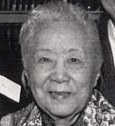
Chinese American Experimental Physicist and Founder, Committee of 100
The First Lady of Physics. The Chinese Marie Curie. Madame Wu. Chien-Shiung Wu was only about five feet tall, but she was a giant in the field of physics.
On Christmas Eve 1956, Wu boarded a train to New York bearing news that would upend thirty years of accepted physics. Her experiment had proven the universe was “slightly left-handed.” She had tested the behavior of subatomic particles and proved that objects that are mirror images of each other behave in different ways, unlike what Parity Law suggested.
Astrophysicist Janna Levin says Wu’s discovery helps explain why there was more matter than antimatter after the Big Bang—in short, why the universe we know even exists at all. Despite shifting the foundations of nuclear physics, Wu was shut out of the Nobel Prize. The award only went to her theoretical physicist colleagues Tsung-Dao Lee and Chen Ning Yang.
But Wu was used to adversity in pursuit of learning. Born May 31, 1912, she was fortunate to have progressive parents who believed in education for everyone. She first attended a school for girls founded by her father, then left home at 11 to attend a highly selective girls’ school in Suzhou. A biography of Marie Curie inspired her love for physics. At night, she would borrow physics and math books from classmates in pursuit of her passion.
Wu studied physics at National Central University in Nanjing. At 24, she boarded an ocean liner for the United States in pursuit of her postdoctoral degree. Though she earned her PhD from the University of California, Berkeley, the university didn’t offer her a permanent position. None of the top twenty research universities had any female physics professors. Wu eventually found positions teaching at Smith College and then at Princeton, where she became the first woman to join the university’s physics department.
In 1944, Columbia University recruited her as a senior scientist on the Manhattan Project to develop an atomic weapon, a project she would later advise Chinese nationalist leader Chiang Kai-shek against when she visited Taiwan in 1965.
It was at Columbia where she devised the “Wu Experiment,” her most significant work. Beyond this, her research crossed into biology and medicine, studying the molecular changes in red blood cells that cause sickle-cell disease. She worked at Columbia until retiring in 1980.
Wu’s life was dedicated to science despite the adversities she faced in a male-dominated field. Her 1965 book “Beta Decay” is standard reading for nuclear physicists. She amassed many firsts: first woman to receive the National Academy of Sciences’ Comstock Prize in Physics; the National Medal of Science in 1975; the first Wolf Prize in Physics in 1978. She even has an asteroid named after her, the “2752 Wu Chien-Shiung.”
Her scientific stature and life experience, living through the Japanese attack on China and World War II, gave her a unique perspective on U.S.-China relations. Over her career, she met people like Pope John Paul II, President Gerald Ford, and Zhou Enlai, the first premier of the People’s Republic of China, as China reopened to the West in the 1970s.
In 1990, Wu joined architect I.M. Pei, cellist Yo-Yo Ma, and other influential Chinese Americans as founding members of the Committee of 100, dedicated to empowering Chinese Americans and bridging U.S. and China. “I have confidence in humankind,” Wu once said. “I believe we will one day live together peacefully.” It was a fitting final chapter for a woman who had spent her life bridging worlds—East and West, theory and experiment.
Wu died February 1997, at 84. Her ashes rest with her husband’s in the courtyard of her father’s school in China, where unconventional parents believed their daughter deserved to understand the universe.