March 4, 2025 [Virtual Event]
Fair Housing Rights & Alien Land Laws: Challenges and Advocacy for the Asian American Community. Watch the replay here.

Committee of 100’s ongoing effort to track and classify legislation that restricts property ownership by foreign governments, businesses, and people shows a continuing effort by state governments and Congress to limit the ability of such entities to own property in the U.S.
While some laws restricting the ability of adversarial governments to own property in the U.S. may protect national security interests, Committee of 100 believes that passage of laws prohibiting property ownership by everyday citizens of foreign countries legitimizes harmful and xenophobic claims about immigrants that exacerbate anti-Asian violence against U.S. citizens and non-citizens alike.
Page contents
Indiana’s new law significantly expands foreign property ownership restrictions
Indiana’s SB 256 passed into law (P.L. 131-2026), prohibiting governmental entities of, businesses headquartered in, and nonresident aliens that are citizens of China, Russia, North Korea, and Iran from purchasing all property in the state. It additionally prohibits leasing non-residential property or leasing residential property for more than 24 months. The law went into effect July 1, 2026, and significantly expands on Indiana’s previous law that prohibited foreign ownership of agricultural land and land near military installations.
Bills restricting foreign property ownership are becoming increasingly broad
South Carolina’s SB 1065 (2026) is one of the most comprehensive foreign property restriction bills introduced by a state since 2021. The bill bans all non-resident aliens from owning or leasing any property in the state and requires divestiture of all currently owned or leased property. The bill goes further to ban property ownership by any person “affiliated” with a government or foreign nongovernment person of China, Russia, North Korea, and Iran. SB 1065 defines “affiliated” as “belongs to, is connected with, is a member of, represents, or acts on behalf of […].” Although this bill did not pass this year, it may indicate a trend toward future state legislation adopting similar language and broad scope.
“The Ban Chinese Communist and Islamist Home Ownership Act” (HR 8906), introduced in the House in May and currently undergoing consideration in the chamber, prohibits purchase, ownership, and requires divestiture of all housing by non-U.S. citizens that are also citizens of China, Russia, North Korea, or Iran. The bill also prohibits home ownership by persons affiliated with the government of China, Cuba, Iran, North Korea, or Russia. Unlike South Carolina’s SB 1065, this bill does not define “affiliated,” nor does it distinguish between U.S. citizens and non-U.S. citizens in this context, leaving significant discretion to enforcing agencies.
USDA and Congress are pushing for a more stringent AFIDA
The USDA’s recently proposed rule (June 25, 2026) for administering the Agricultural Foreign Investment Disclosure Act of 1978 (AFIDA) places harsher penalties on citizens of China, Russia, North Korea, and Iran for disclosure failures. The new proposed rule also:
Congress is also considering a wide range of related bills that would amend the AFIDA statute itself, creating more stringent reporting requirements and harsher penalties than the proposed rule (S. 845, S. 886, HR 4362).
Congress’ Farm Bill gives substantial discretion to the President to restrict foreign agricultural land ownership
Congress’ 2026 Farm Bill, which passed in the House and is currently being considered in the Senate (the furthest a farm bill has progressed since 2018), includes extensive restrictions on agricultural land ownership by a range of foreign entities, prohibiting the purchase of all agricultural land in the U.S. by the governments of China, Cuba, North Korea, Iran, Russia, and Syria or any person affiliated with one of those countries (SEC. 12306). Specifically, the bill:
Regarding legislative efforts to prevent Chinese citizens and businesses from owning property in the United States, Chinese businesses and citizens own 0.5% of all privately held, foreign-owned agricultural property, according to the Department of Agriculture’s most recent 2024 AFIDA annual report data. According to the 2024 AFIDA annual report, privately held, foreign-owned agricultural land accounts for 3.6% of all privately held agricultural land in the United States (96.4% is domestically-owned). Put differently, Chinese ownership represents .018% of privately held agricultural land in the United States, or about 1 out of every 5,600 acres, a decrease of about 14% from 2023.
These are the substantive foreign property ownership laws passed so far in 2026:
Download our comprehensive report from June 2026 summarizing and analyzing the legislation and litigation landscape here.
As of August 13, 2026:
Since 2021:
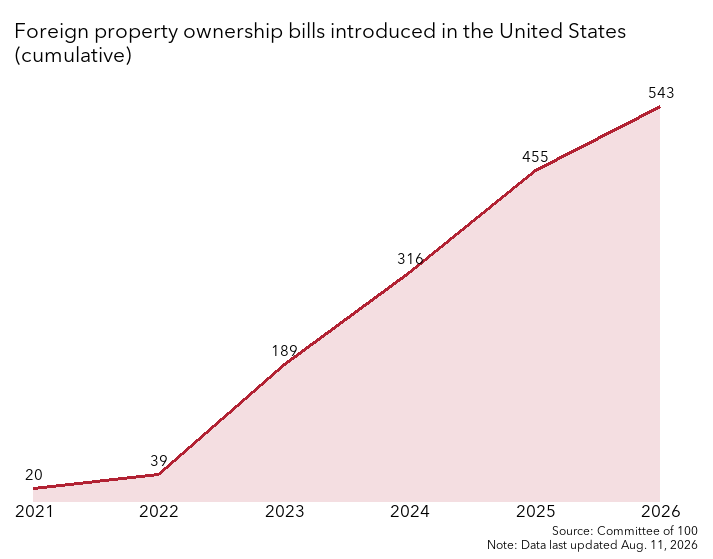
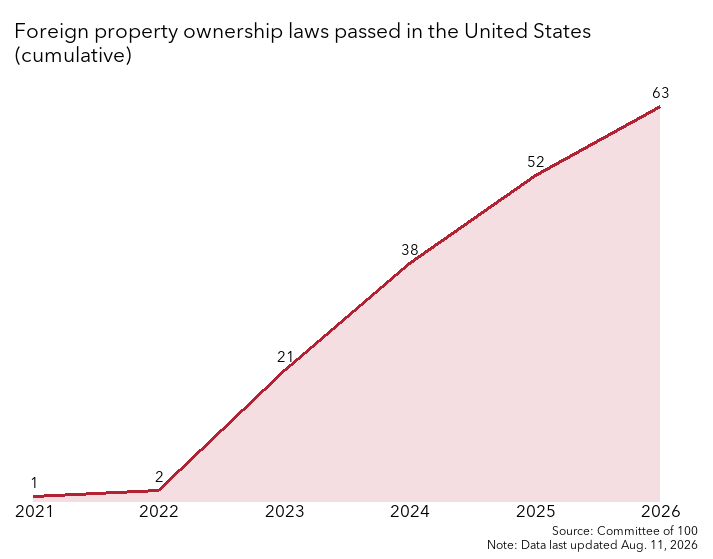
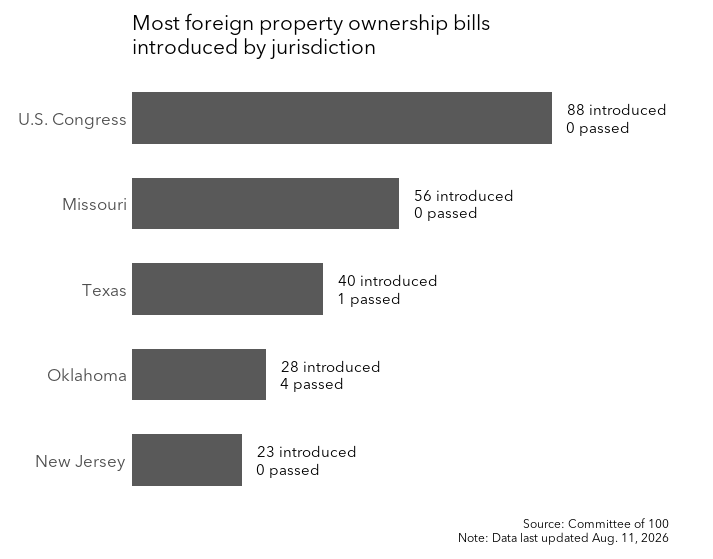
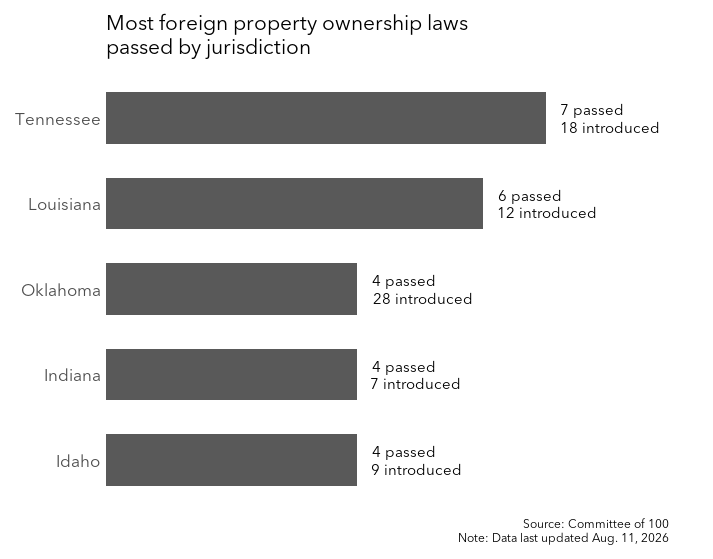
The provisions contained in this legislation encompass a wide range of restrictions on an extensive variety of properties by a large array of foreign entities and their respective countries. The interactive mapping tool illustrates legislative activity by state governments and Congress pertaining to restriction of property ownership by foreign citizens, businesses, and governments.
The following template illustrates the general formula of each bill: Some entity (e.g. governments, nonresident aliens) belonging to some country(ies) (e.g. all foreign countries, foreign adversaries, China) are restricted from having some interest (e.g. restricted from owning, leasing, or are regulated in some other way) in some property (e.g. all real property, agricultural property, state land). The glossary below the apps detail the terms used.
The first tab of the mapping tool below allows users to navigate across this legislative landscape by specifying the combination of provisions they are interested in through the dropdown menus above the map. The map highlights the intersection of the selected provisions. Clicking a state (or “U.S.,” which refers to federal legislation) provides a detailed summary of all legislation currently being considered or passed into law, as well as any constitutional provisions related to foreign property ownership. Note that failed bills are included in the statistics described above (among bills that have been introduced) but are excluded from the map to reduce congestion. Additionally, to highlight constitutional provisions, all other menu menu selections must be omitted.
The second tab provides a map of all state and federal code related to foreign property ownership rights and restrictions as of August 12, 2026.
The third tab highlights litigation against states’ foreign property ownership laws: summarizing complaints, decisions made, and the current status of these lawsuits. As of August 12 there are 8 such cases: 2 in Arkansas, 2 in Florida, 1 in Tennessee, and 3 in Texas.
The data explorer allows users to view the legislative landscape in a second way; by selecting a bill status and provision category, users may view the distribution of provisions contained in bills for a given bill status-provision category combination. For instance, the default selections show the distribution of foreign country groups among bills currently being considered by state legislatures and Congress. For instance, the 55 total bills currently being considered, 17 contain provisions that restrict property ownership by Foreign Adversaries.
Entity types
Foreign country groups
Restrictions
Property types
State constitution
Committee of 100 would like to thank Harrison M. Pittman, Director of The National Agricultural Law Center; Yu Wang, PhD student at the Edward J. Bloustein School of Planning and Public Policy at Rutgers University; and Vanessa Soto, Diversity & Inclusion Editor of the Boston University Law Review, for their research that has greatly aided this project. If you have a comment or know of new bills that have recently been proposed, please email Committee of 100 Research and Data Scientist Sam Collitt at scollitt@Committee100.org.
Fair Housing Rights & Alien Land Laws: Challenges and Advocacy for the Asian American Community. Watch the replay here.
From Past Prejudice to Present Policy: The Impact of Land Ownership Exclusion Laws on Diverse Communities. Watch the replay here.
—————————————————–
Committee of 100’s alien land law map and the March 4 webinar were featured by Chinese in US in this piece.
Committee of 100’s alien land law map, as well as the March 4 webinar, were featured in this story by The Visible Together.
Committee of 100’s update to the alien land laws map and data was spotlighted in this AsAmNews article.
Committee of 100’s data on alien land laws spotlighted in this VOA News article on foreign farm ownership.
Committee of 100 Interim President Cindy Tsai quoted on recent alien land law push in Texas in this Yahoo News! / Next Shark feature story.
The term “alien land laws” started in the mid-19th and early 20th centuries with the Western states in the U.S. attempting to limit the presence and permanence of Chinese and Japanese immigrants by forbidding “aliens ineligible for citizenship” from purchasing, and later from leasing property in the states in which these laws were passed. For example, In Oregon’s 1859 constitution, it stated that no “Chinaman” could own property in the state, and it protected specifically the rights of “white foreigners” the same property owning rights as enjoyed by native citizens.
On April 29, 1878, the Ninth Circuit Court in California denied Ah Yup the right to naturalize. The court did this by citing the 1802 naturalization laws and all revised statutes that had been passed since. At the time of Ah Yup’s petition, the laws granted all “free white persons” as well as all “aliens of African nativity, and persons of African descent” the right to naturalize. This led to the Chinese Exclusion Act of 1882, which explicitly excluded Chinese immigrants from citizenship.
As U.S.-China relations have deteriorated, fears about Chinese influence and espionage have increased. Alien land laws are often framed as a way to limit foreign control of strategic assets, such as farmland, real estate near military bases, or critical infrastructure. Politicians have justified these laws by citing concerns about national security, particularly regarding potential surveillance or foreign ownership of resources critical to food and energy supplies.
Lastly, the increasing racism and xenophobia that has targeted Chinese and Asian Americans in the wake of the COVID-19 pandemic has contributed to increasing treatment of Asian citizens and immigrants as perpetual foreigners.
Alien laws have often reflected societal fears or biases. For example, the Chinese Exclusion Act of 1882 in the U.S. barred Chinese immigrants under the guise of protecting jobs, but it was largely rooted in racial prejudice. Policies today must be critically examined to ensure they address genuine national interests without being discriminatory. Transparent justification and public accountability are essential to avoid perpetuating exclusionary practices. Language in policies and public discourse matters. Framing immigration and alien laws in inclusive terms can prevent xenophobia and build public trust in the system.
Many alien laws have shifted based on economic need. For instance, during labor shortages in wartime, the U.S. instituted the Bracero Program (1942-1964) to bring in Mexican workers, even while other restrictive laws were still in place. As global economies evolve, immigration laws should be flexible enough to adapt to workforce demands while protecting worker rights—both for citizens and immigrants.
Ordinary citizens play a crucial role in preventing the rise of restrictive alien land laws, which historically have been used to limit land ownership or rights for immigrants and non-citizens. Some recommendations include the following:
Educate Yourself and Others: learn about the history of alien land laws which targeted Japanese and Chinese immigrants, preventing them from owning land and building generational wealth. Through this education, share this knowledge with others through conversations, social media, or community events to highlight how such laws have historically perpetuated inequality and racial discrimination.
Advocate for Fair Legislation: contact your local, state, and federal representatives to express opposition to discriminatory laws and advocate for policies that promote equal rights for all residents, regardless of citizenship or immigration status.
Build Coalitions: partner with organizations like APA Justice, Committee of 100 and others that work with immigrants and non-citizens to amplify their voices and protect their rights. Work with advocacy groups, faith organizations, and civil rights coalitions to create a broad-based movement opposing discriminatory laws.
Challenge Discriminatory Narratives: alien land laws are often rooted in xenophobic or protectionist rhetoric that portrays immigrants as threats to national security or the economy. Challenge these myths by sharing facts and emphasizing the contributions of immigrants to society.
Vote and Participate in Local Politics: vote for candidates who advocate for immigrant rights and oppose discriminatory legislation. Attend city council or state legislature meetings to voice concerns about alien land laws and ensure immigrant voices are included in policymaking.
If these alien land laws restrict foreign ownership or investment, some industries may be forced to scale back, resulting in fewer jobs and less economic activity in local markets. This could be particularly challenging for rural or economically underdeveloped regions that rely on foreign investment for growth and infrastructure. Over time, this could stifle local economies, reducing opportunities for entrepreneurship and limiting access to capital for small businesses.
Some of these laws also restrict the ability of immigrants to buy homes and gain an economic foothold in the United States.
These laws also create a sense of exclusion for immigrant communities, particularly Chinese Americans and other Asian groups, who may be disproportionately targeted by the perception that they are responsible for “outsider” investment in local property markets. The rhetoric around these laws often includes stereotypes that associate certain ethnic groups with negative economic effects, creating divisions and reinforcing prejudices and xenophobia.