

Q&A Series – Next Generation Leaders: Andrew Lee
4th November 2026
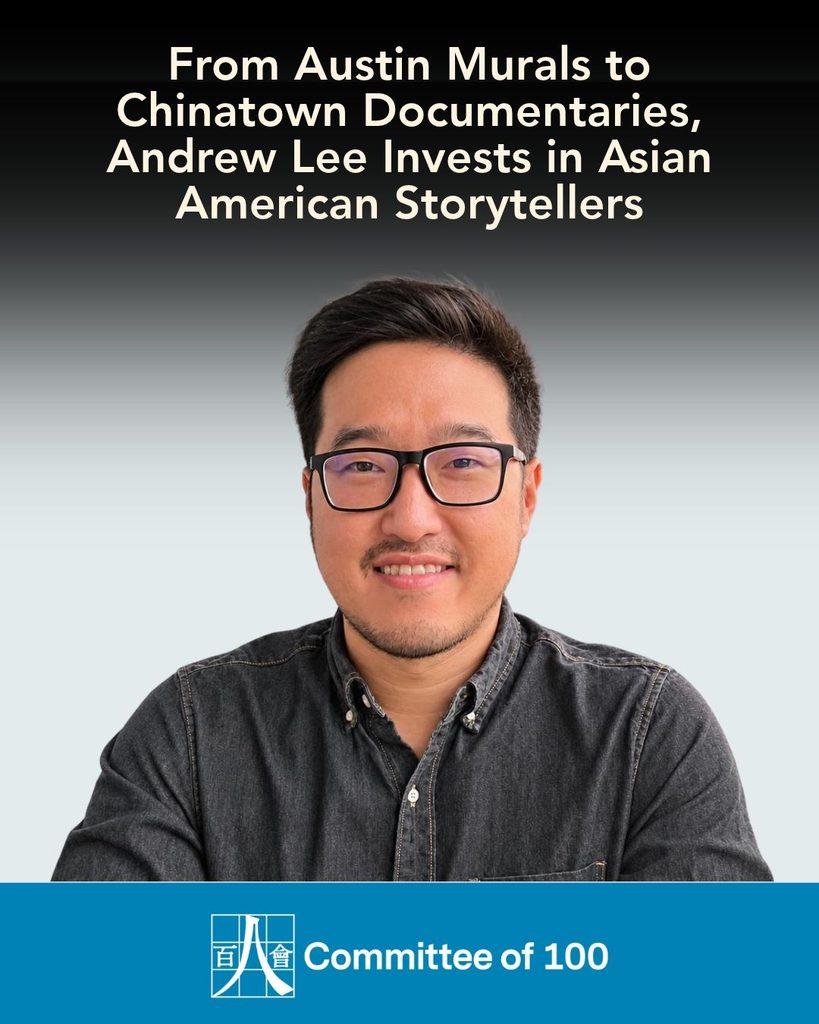
Andrew Lee is an independent film producer and Executive Director of The Lunar Foundation, a 501(c)(3) he co-founded to build economic pathways for AANHPI artists in Central Texas. He stewards the 26-year-old Austin Dragon Boat Festival, now under the first City of Austin co-sponsorship ever granted to an AANHPI cultural event, and co-produces NightMarket.fun with the Greater Austin Asian Chamber of Commerce. Through his company Amplify Asian, he commissioned the AAPI Heroes Mural Campaign, large-scale public murals of historical AANHPI figures across Greater Austin, now in its second round with renewed city funding. He is currently producing documentaries on Herlinda Wong Chew, a Chinese American pioneer whose story connects Chinese immigration, the Mexican Revolution, and Texas border history, and on MasterChef winner Christine Ha, and serves as executive producer on a forthcoming short documentary on 9/11 as witnessed from Manhattan’s Chinatown.
Lee has produced award-winning documentaries and features released by MGM/Orion Pictures, IFC Films, PBS, and others, including Jump Shot: The Kenny Sailors Story (SXSW 2019), Seadrift (Slamdance 2019, PBS Reel South), and Balls Out (MGM/Orion, New York Times Critics’ Pick). Alongside his film career, he spent nearly a decade as a live music promoter and swing dance community organizer, which shaped his thinking about sustainable economics for working artists. He has also spearheaded sponsored Gold Open screenings in Austin and a Crazy Rich Asians release activation with Warner Bros.
Connect with Andrew on LinkedIn.
###
C100: What inspired you to work in your professional field?
Andrew: I’ve always been drawn to storytelling, but for most of my career I was telling other people’s stories, producing films for non-Asian directors and building community around the arts wherever I could. Two PBS documentaries made me feel what was missing. Who Killed Vincent Chin showed me where anti-Asian sentiment leads. The Chinese Exclusion Act showed me how thoroughly Chinese Americans had been written out of this country’s story. I couldn’t keep working as if those stories weren’t mine to tell. Then I organized a Crazy Rich Asians release activation in Austin, with Warner Bros. sending Ronny Chieng, Chris Pang, Adele Lim, and Pete Chiarelli, and watched a room full of AANHPI and non-AANHPI Austinites respond to the same story. That was the moment I knew what I wanted to build: the infrastructure that lets AANHPI stories reach everyone.
C100: What are some of the challenges you have encountered to become a leader in your respective field? Are Chinese Americans well-represented in your field, and what do you think are the reasons they are/aren’t well-represented?
Andrew: The hardest challenge hasn’t been external. It’s been making the case for AANHPI arts investment within my own community, which too often treats arts and culture as something volunteers should sustain rather than something worth funding. The friction around funding was new to me. When I was producing other communities’ stories, it didn’t exist in the same way. It showed up once I started producing AANHPI stories and building the organizations around them. Gold House and TAAF proved that AANHPI capital can move toward AANHPI culture when it chooses to, and those efforts stood out precisely because they were exceptions. On representation, AANHPI leaders are underrepresented in arts nonprofit leadership, a version of the bamboo ceiling that extends well beyond corporate America. The infrastructure for AANHPI arts in Austin is still being built, and that gap is part of what drew me to take it on full time.
C100: What do you believe needs to be done so that more Chinese Americans feel empowered to follow and achieve their dreams?
Andrew: The community needs to take ownership of its own cultural expression: fund it, protect it, and pay the people who build it. This matters more as AI narrows conventional jobs and more Chinese Americans look to creative industries for opportunity. The money is already real. Chinese American creators are earning millions through audiences of millions. The next step is building that same economic viability across film, fine art, performance, and public art, so the next kid with talent has more than one path that pays. Empowerment isn’t permission. It’s knowing there’s a foundation that will hold you up.
C100: How can your NGL community support you and your work? Do you have any recent or upcoming projects you’d like to highlight?
Andrew: Show up. The Lunar Foundation’s NightMarket.fun is November 14 in Cedar Park, Texas, with more than 100 vendor booths, two stages of Texas AANHPI talent, and Ruby Ibarra and Raina Huang headlining. Our Austin Dragon Boat Festival returns in April 2027, and our Nielsen research on AANHPI artist economics will be presented at SXSW 2027. If you know artists in Greater Austin, forward them our Austin Creates Together survey (https://www.thelunarfoundation.org/austin-creates-together). If your work touches philanthropy or corporate giving, let’s talk: Texas has the same size Asian American community as New York and a fraction of the AANHPI arts funding. Separately, I’m executive producing a short documentary built on never-before-seen 9/11 footage filmed from a fire escape in Manhattan’s Chinatown by a Vietnamese refugee, alongside Oscar-nominated and Emmy-winning filmmakers. Distributors are waiting to see it, and we’re raising the completion funds to get it in front of them.
C100: For those who just recently graduated college or are early in their careers, what advice would you give to them?
Andrew: Being a generalist got me two $100,000 cash prizes, MGM distribution, a New York Times Critics’ Pick, and a SXSW Audience Award, but hard work only got us a better chance at winning the lottery. If you’d rather not gamble, focus on the infrastructure: pick a lane and let it compound. Work with the best people you can find, not just the people you know. Film director Dan Ireland and producer Jeff Dowd gave me that advice early, and it has held up on every successful project since. And if you’re a creative Chinese American deciding where to build a career, consider Texas. Our Asian American population just passed New York’s, the cost of living still lets an artist breathe, and the cultural infrastructure is being built right now. Early arrivals get to shape it.