
Committee of 100 Statement: Where Our Allegiances Are
28th August 2026
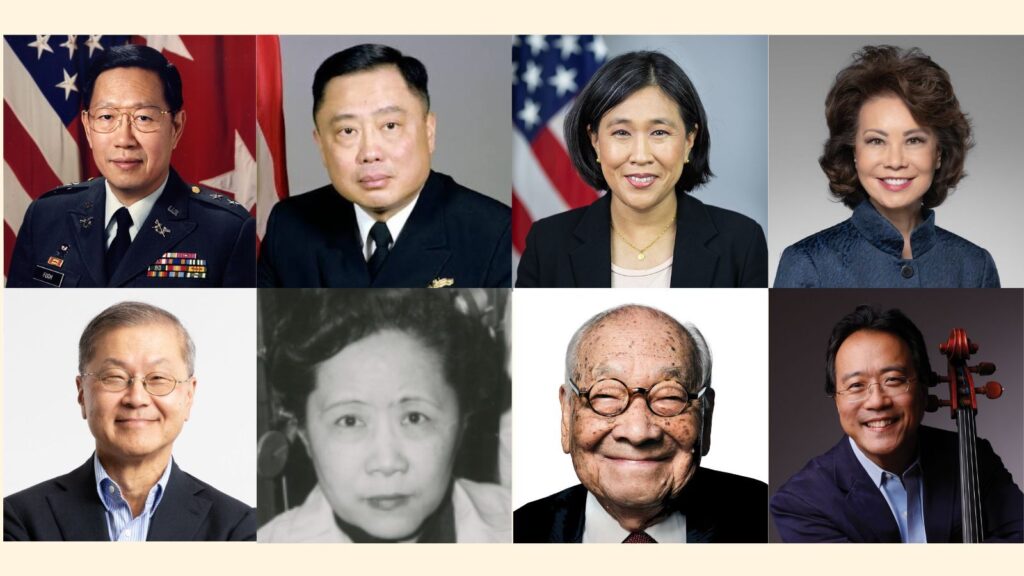
The Committee of 100 applauds the statement by the Congressional Asian Pacific American Caucus (CAPAC) condemning recent comments suggesting Chinese Americans should be incarcerated in the event of an armed conflict with China.
Rather than amplify this rhetoric, we want to use this moment to highlight the long and proud history of Chinese Americans who have served the United States, including in our armed forces and public service.
Below are just a few notable examples from C100 founders, members, and other Chinese Americans whose service reflects this much broader history:
Military service
- Joseph Pierce enlisted in the Union Army in 1862 and fought at Gettysburg, reaching the rank of corporal in 1863 — the highest rank documented for any Chinese American soldier in the Civil War.
- About 20,000 Chinese Americans served in every branch of World War II, many while still barred by federal law from becoming citizens under the Chinese Exclusion Act, repealed only in 1943. Congress awarded the group the Congressional Gold Medal in 2021.
- John Fugh became the Army’s first Chinese American general officer in 1984 and its top uniformed lawyer, The Judge Advocate General, in 1991.
- Ming Chang deployed to Vietnam and became the first naturalized Asian American naval officer to reach flag rank, in 1982.
Cabinet and federal office
- Elaine Chao was the first Asian American woman appointed to a president’s Cabinet, in 2001, and ran two federal departments across 16 years under two presidents.
- Gary Locke was the first Chinese American elected governor of a state, then served as commerce secretary and later as U.S. ambassador to China.
- Steven Chu, a Nobel laureate in physics, served as energy secretary from 2009 to 2013.
- Katherine Tai led U.S. trade negotiations with Beijing as U.S. trade representative from 2021 to 2025.
Science, medicine and space
- Chien-Shiung Wu worked on the Manhattan Project’s uranium-enrichment process during World War II and later disproved the law of parity conservation, work that won two male colleagues the 1957 Nobel Prize.
- David Ho led development of the antiretroviral therapy that turned HIV from a near-certain death sentence into a manageable disease.
- An Wang patented the write-after-read method that made magnetic-core memory practical, powering most computers built through the 1970s.
- Leroy Chiao commanded the International Space Station in 2004-05, the first Chinese American to command a space mission.
Arts and cultural diplomacy
- I.M. Pei designed the National Gallery of Art’s East Building, the John F. Kennedy Presidential Library and the Louvre Pyramid, and won the Pritzker Prize in 1983.
- Yo-Yo Ma has won 20 Grammy Awards, received the National Medal of Arts and the Presidential Medal of Freedom, and was named a United Nations peace ambassador in 2006. Ma, Pei and Wu were among the six founding members of the Committee of 100 in 1990.
- Janet Yang was the first Asian American president of the Academy of Motion Picture Arts and Sciences.
This is not the first time the question has been asked. In 1999, Los Alamos scientist Wen Ho Lee was accused of spying for China and held for nine months in solitary confinement before nearly all 59 charges against him were dropped; the federal judge who freed him apologized for how he’d been treated. The Committee of 100 has answered this question before. We are answering it again.
Most of the nation’s 5.5 million Chinese Americans do not run federal departments or command space missions. They teach classes, treat patients, run businesses, write software, serve on juries and vote. Four in 10 were born in the United States. Six in 10 of those born abroad have naturalized. Two in three own their homes.
That is not a divided loyalty. It is an ordinary American life, built here. Yet a 2026 Committee of 100 survey found that U.S.-born Asian Americans continue to be viewed as perpetual outsiders, facing race-based discrimination and questioning of their belonging at higher rates than any other racial group in the nation.
Chinese Americans have been answering the question of our allegiance, on the record, for more than 160 years. What’s overdue is for the country to stop asking it.
About Committee of 100
Committee of 100 empowers Chinese Americans and bridges America and China, leading with vision and purpose. For over 30 years, we have been the preeminent non-profit leadership organization of distinguished Chinese Americans, advancing full participation in American society and constructive U.S.-China relations through groundbreaking research, policy analysis, leadership development and civic engagement. Learn more at committee100.org.
Media Contacts:
Committee of 100
Sam Jones, Communications Specialist, sjones@committee100.org