
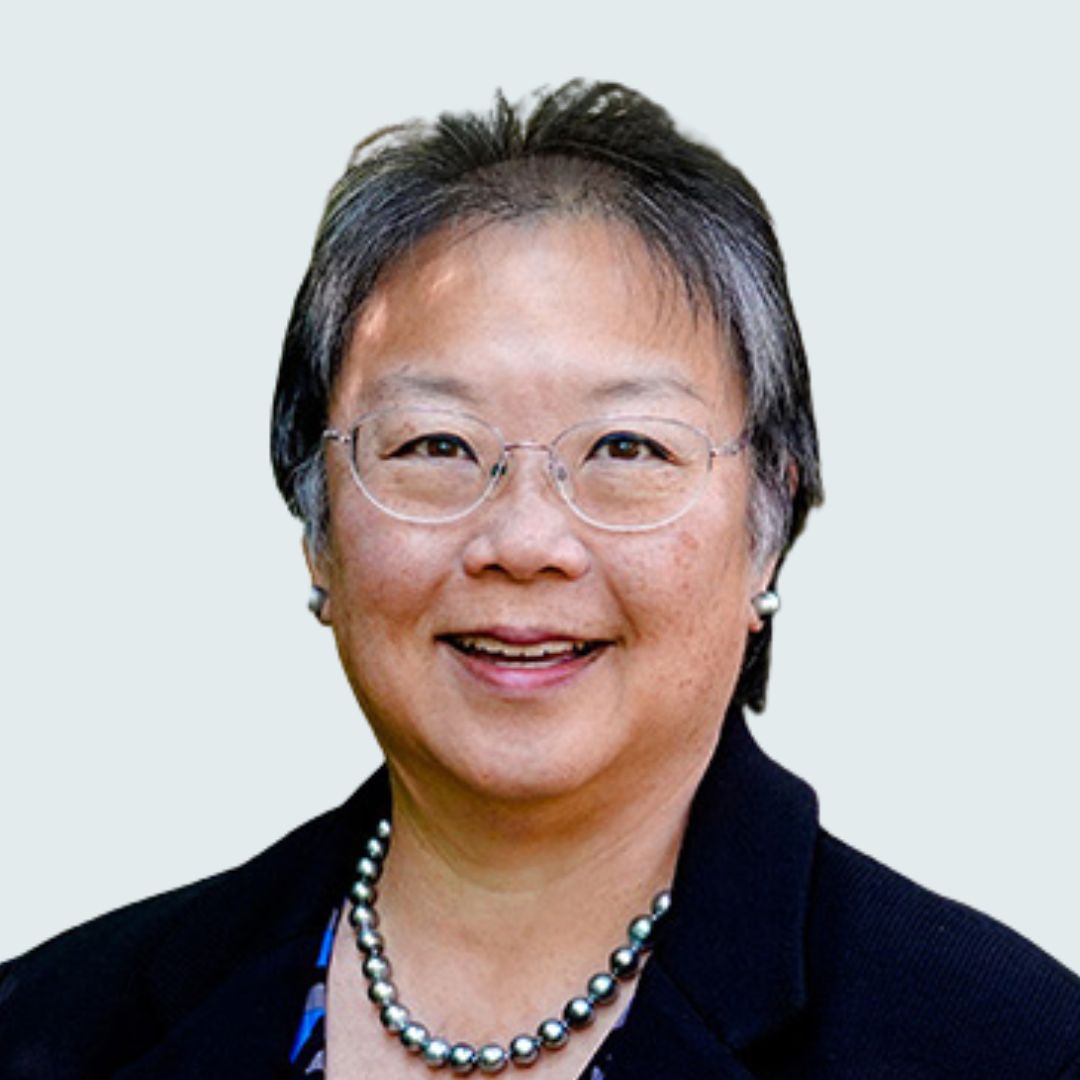
Daphne Kwok has spent nearly four decades building the infrastructure of Asian American Pacific Islander civic power — the organizations, coalitions, research panels, and pipelines of talent that the community didn’t have when she started. But she didn’t set out to do any of it.
The answer to how she got from there to here starts with her parents, who were progressive immigrants from Shanghai who came to the U.S. for higher education and stayed, building and being part of the community. Her father served as president of their local youth symphony and on the school boards; her mother ran a Suzuki music institute. Service, for the Kwoks, wasn’t an extracurricular. It was a family identity.
Kwok’s path became even clearer at Wesleyan University, where she found something she’d never had before: peers. As one of 29 AAPI students in a freshman class of 600, she initially joined the Wesleyan Asian Interest Group just to make friends. “I thought I was just having fun socializing,” she says. “I never knew that coordinating events, advocating for funding, working with African American and Hispanic students to push for more student and faculty representation, and meeting with the university president and senior administrators would become the tools in my career toolbox.”
Those tools came out in 1990, when Kwok became executive director of the Organization of Chinese Americans. She and the Japanese American Citizens League DC Representative were the only AAPI voices in rooms with the White House, Congress, and the national media. “If we weren’t at the table,” she says, “there were no Asian Americans at the table.” In those early years, to advance the AAPI community, OCA and JACL’s membership in the Leadership Conference on Civil Rights, along with members like the NAACP, the National Council of La Raza, and the American Jewish Committee, was key to having a voice in DC. The tumultuous 1990s positioned Kwok as a national spokesperson for a nearly invisible AAPI community.
Building the AAPI Washington infrastructure piece by piece, Kwok left her mark on many organizations: as a founder and executive director of the Asian Pacific American Institute for Congressional Studies, and as the first Chair of the National Council of Asian Pacific Americans — a role to which her own peers elected her. She eventually moved to San Francisco to lead the Angel Island Immigration Station Foundation.
Kwok’s career reached an apex in 2010, when President Barack Obama appointed her chair of his Advisory Commission on Asian Americans and Pacific Islanders — the “eyes and ears” of the community for the President and the federal government. Data disaggregation was a top priority, and that single agenda item led to one of Kwok’s most consequential, if least visible, contributions: co-building Amplify AAPI, a research panel of more than 3,000 Asian Americans, Native Hawaiians, and Pacific Islanders. The panel now powers major national surveys, including Committee of 100’s own State of Chinese Americans research.
Ask Kwok what she’s proudest of, though, and she won’t point to a title or a policy win. She’ll point to her former interns and staff: C100 member Christine Chen, now leader of APIAVote; Giles Li, former CEO of the Boston Chinatown Neighborhood Center; and Candace Yu, formerly of the White House Office of Presidential Personnel. “Never burn your bridges,” Kwok says, “because you never know who will be processing your presidential paperwork.”
Today, Kwok serves as Board Secretary of Committee of 100, an organization she sees as essential to protecting and advancing the welfare of Chinese Americans and Asian Americans domestically. She has been leading AAPI audience strategy at AARP and serves on the boards of Arena Stage and the National Museum of American History. All of it continues a lifelong mission to dismantle two of the most damaging stereotypes facing Asian Americans — the Model Minority Myth and the Perpetual Foreigner.
For Kwok, her mission runs on two tracks: “Empowering the Asian American, Native Hawaiian, and Pacific Islander communities and supporting the African American and Hispanic communities, so that we can never be used as a wedge against each other.”