Civic Engagement

State and federal lawmakers are setting new rules for how U.S. colleges and universities work with foreign scientists, students, and institutions
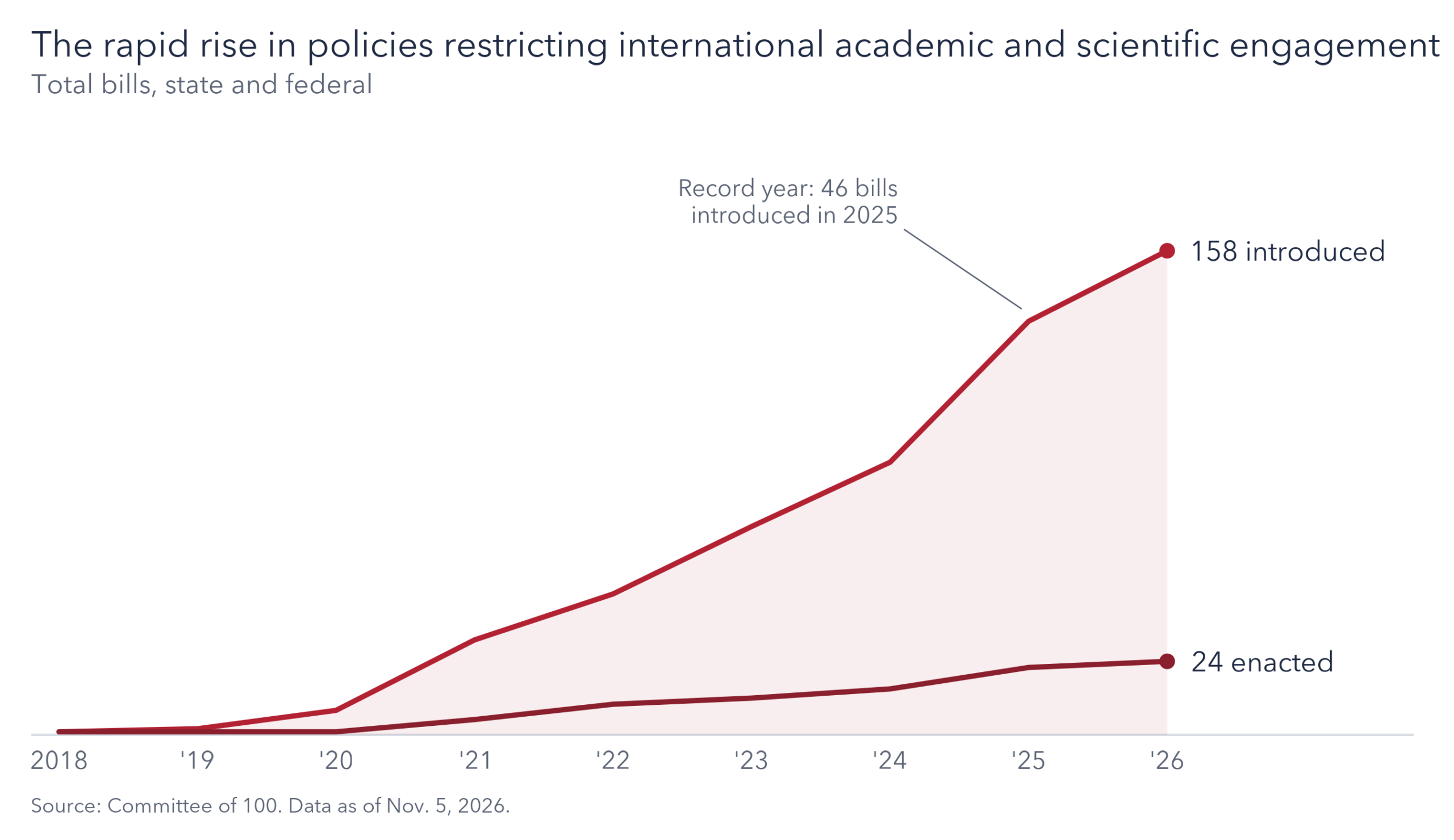
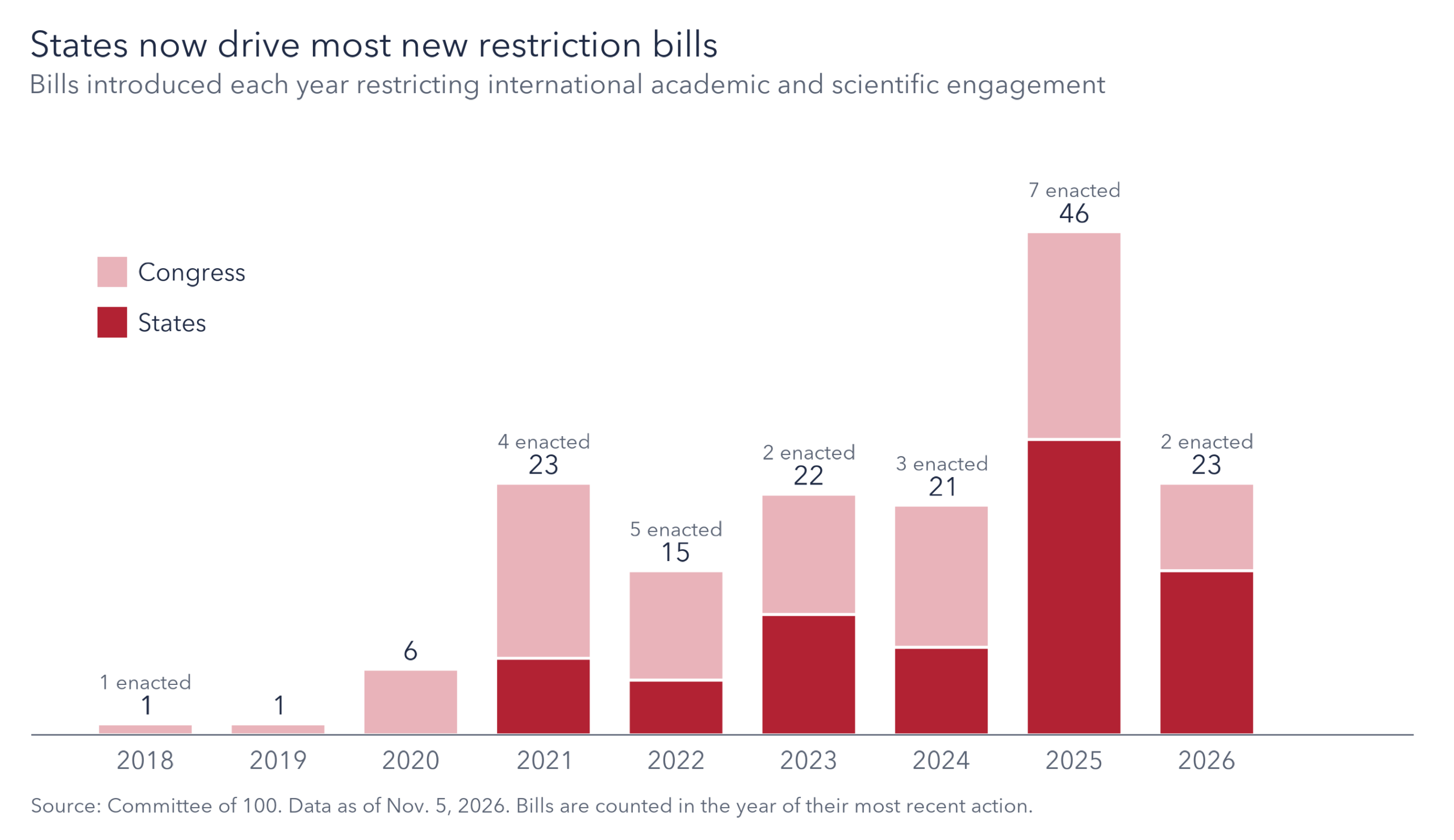
Since 2018, Congress and 23 states have introduced 158 bills that would restrict international scientific and academic engagement at U.S. colleges and universities. 24 have become law: 16 in 7 states and 8 in Congress. Activity peaked in 2025, with 46 bills introduced and 7 enacted. In 2026, lawmakers in 14 states took up new bills, 5 of them for the first time.
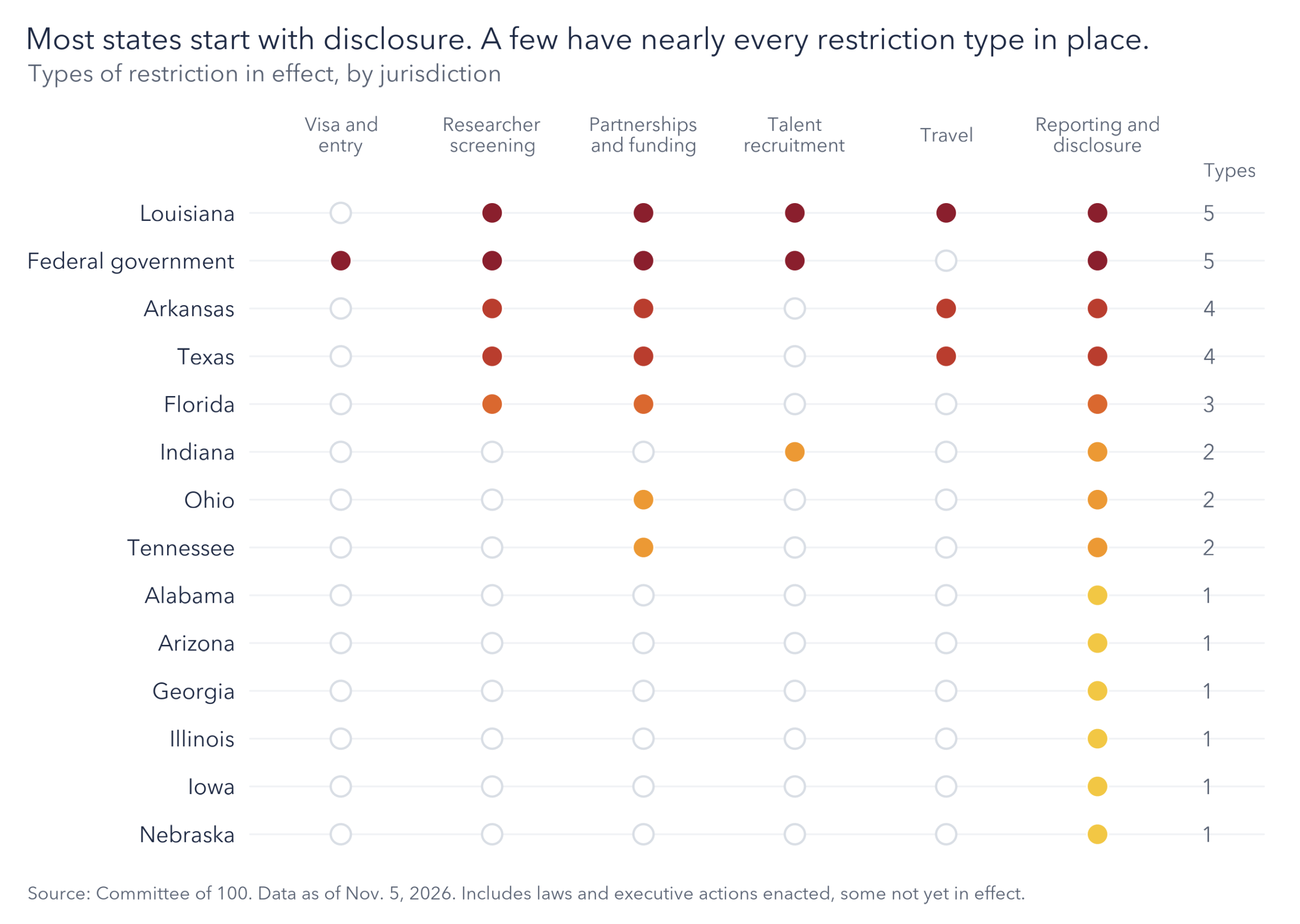
These policies limit how colleges and universities collaborate with foreign institutions, enroll foreign students, and hire foreign researchers and faculty. Arkansas, Florida, Indiana, Ohio, Tennessee, and Texas have passed such laws, and Louisiana significantly expanded its law this year. Federal agencies have added their own limits through executive orders, rules, and conditions on research funding. In 2026, they proposed rules that would bar federal funds for many international collaborations and limit how long foreign students may study in U.S. programs.
Many of these policies name China directly or rely on federally defined lists that include it, such as “Foreign Adversaries.” As a result, they apply most directly to students and researchers who hold Chinese citizenship or have ties to China. Chinese American students, scholars, and faculty can also face added scrutiny, whatever their citizenship.
Policymakers that introduce these efforts maintain that they are needed to protect U.S. research from theft by foreign governments. Researchers have studied their effects on scientific output, on where scientists and students choose to work and study, and on the economy. One study estimates that proposed federal changes to student visas and work authorization could reduce international enrollment by about a third (Clemens et al. 2025).
Committee of 100 built this tracker so that policymakers, researchers, university leaders, and the Chinese American community can see in one place what these policies say, where they apply, and how they are changing. The tracker:
Below the map, a summary of trends highlights what is new in 2026, and a research summary describes what studies have found about the effects of restricting international engagement and of keeping it open.
The map has two tabs. Policies in place shows laws and executive actions now in effect, with states shaded by how many types of restriction they have adopted. Legislative activity shows bills that are pending or have passed into law. Use the buttons above each map to filter, and hover over a button to see what it covers. Click a state, or “US” for federal policy, to read a summary.
The federal policies shown focus on those adopted since 2018. Bills that failed are not shown on the map, but they are counted in the figures below.
New in 2026
At the federal level:
In the states:
These policies are one part of a broader set of limits on research and academic freedom in the U.S. (Fernandez and Hutchens 2025). Their costs are well documented. Their security benefits are not: “while the economic and health returns to science are increasingly well measured, the national security consequences of scientific openness or restriction remain less well understood” (Ganguli and MacGarvie 2026, 23).

Restrictions slow American science
Restrictions push talent elsewhere
Restrictions hurt American students and workers
Openness pays off
If you have a comment or know of new bills or policies that have recently been proposed, please email Committee of 100 Research Lead, Sam Collitt, at scollitt@Committee100.org.
Beine, Michel, Giovanni Peri, and Morgan Raux. 2024. “The Contribution of Foreign Master’s Students to US Start-Ups.” https://doi.org/10.3386/w33314.
Chellaraj, Gnanaraj, Keith E. Maskus, and Aaditya Mattoo. 2008. “The Contribution of International Graduate Students to US Innovation.” Review of International Economics 16 (3): 444–62. https://ideas.repec.org//a/bla/reviec/v16y2008i3p444-462.html.
Clemens, Michael A, Jeremy Neufeld, and Amy M Nice. 2025. “Brain Freeze: How International Student Exclusion Will Shape the STEM Workforce and Economic Growth in the United States.”
Doran, Kirk, and Chungeun Yoon. 2018. “Immigration and Invention: Evidence from the Quota Acts.”
Fernandez, Frank, and Neal Hutchens. 2025. “Restrictions on US Academic Freedom Affect Science Everywhere.” Nature Human Behaviour 9 (7): 1303–4. https://doi.org/10.1038/s41562-025-02248-9.
“First International Researchers Hosted at Aix-Marseille University.” 2026. https://www.enseignementsup-recherche.gouv.fr/en/first-international-researchers-hosted-aix-marseille-university-100490.
Flynn, Robert, Britta Glennon, Raviv Murciano-Goroff, and Jiusi Xiao. 2024. “Building a Wall Around Science: The Effect of u.s.-China Tensions on International Scientific Research.” https://doi.org/10.3386/w32622.
Ganguli, Ina, and Megan MacGarvie. 2024. “International Students’ Migration: Immigration Policy and Implications for Innovation.” Forthcoming Chapter in Volume.
———. 2026. “Science Without Borders? Waxing and Waning Integration in Global Scientific Research and Innovation.” NBER Chapters.
Gridneff, Ilya, and Andrew Jack. 2026. “Canada Poaches 48 Top US-Based Academics.” Financial Times, August. https://www.ft.com/content/8cc488a5-54c2-41f9-8b87-327ff591be6a?syn-25a6b1a6=1.
Jia, Ruixue, Margaret E. Roberts, Ye Wang, and Eddie Yang. 2024. “The Impact of USchina Tensions on US Science: Evidence from the NIH Investigations.” Proceedings of the National Academy of Sciences of the United States of America 121 (19): e2301436121. https://doi.org/10.1073/pnas.2301436121.
Kerr, William R, and William F Lincoln. 2010. “THE SUPPLY SIDE OF INNOVATION: H-1B VISA REFORMS AND US ETHNIC INVENTION.”
Milani, Sahar, and Linh Pham. 2025. “Sanctions and Global Collaboration in Innovative Activities.” The World Economy 48 (4): 690–724. https://ideas.repec.org//a/bla/worlde/v48y2025i4p690-724.html.
Moser, Petra, and Shmuel San. 2020. “Immigration, Science, and Invention. Lessons from the Quota Acts.” https://doi.org/10.2139/ssrn.3558718.
Peri, Giovanni, Kevin Shih, and Chad Sparber. 2015. “STEM Workers, H-1B Visas, and Productivity in US Cities.” Journal of Labor Economics. https://www.journals.uchicago.edu/doi/10.1086/679061.
“Research Security Policies and Their Impacts: Key Results of APS Member Survey.” 2021. https://www.aps.org/publications/reports/research-security-policies-survey.
Shih, Kevin. 2017. “Do International Students Crowd-Out or Cross-Subsidize Americans in Higher Education?” Journal of Public Economics 156 (December): 170–84. https://doi.org/10.1016/j.jpubeco.2017.10.003.
Witze, Alexandra. 2025. “75.” Nature 640 (8058): 298–99. https://doi.org/10.1038/d41586-025-00938-y.
Xie, Yu, Xihong Lin, Ju Li, Qian He, and Junming Huang. 2023. “Caught in the Crossfire: Fears of Chineseamerican Scientists.” Proceedings of the National Academy of Sciences 120 (27): e2216248120. https://doi.org/10.1073/pnas.2216248120.