



Civic Engagement, Public Policy, Public Policy Engagement, Webinar
From Past Prejudice to Present Policy: The Impact of Land Ownership Exclusion Laws on Diverse Communities
About the Event
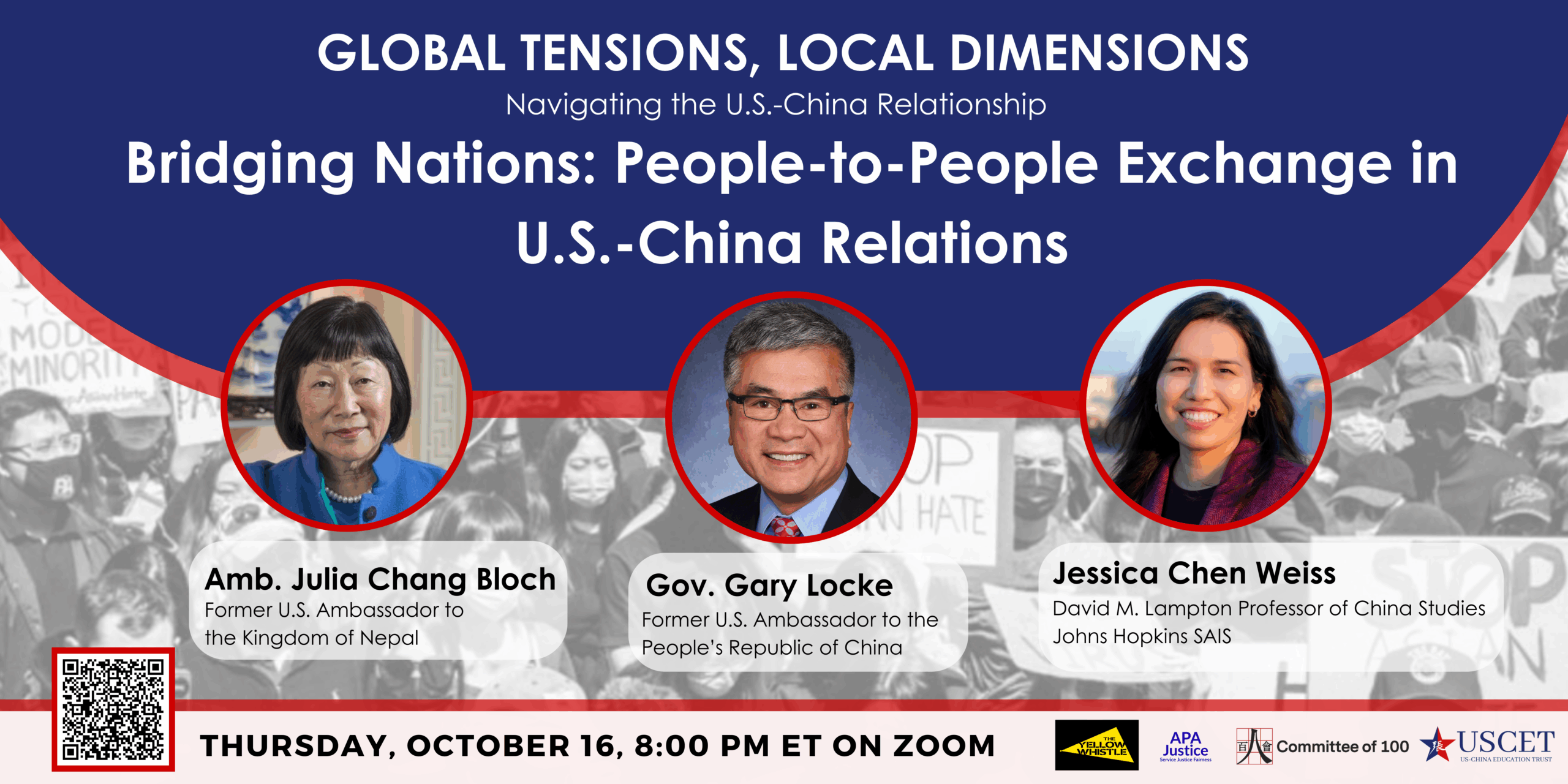
From the ping-pong diplomacy that preceded formal diplomatic ties in the 1970’s to the robust educational exchanges that flourished in the reform era in the 1990’s, people-to-people connections have provided continuity during periods of political tension in the U.S.-China relationship. Yet in today’s environment of strategic competition, people-to-people engagements, such as academic partnerships, student exchanges, business networks, and diaspora community ties, are increasingly restricted in the name of national security. Asian American and Pacific Islander (AAPI) communities, whose families and networks often span both countries, increasingly find themselves in the crosshairs. This webinar focused on the past, present, and future of people-to-people ties between the United States and China, as well as the implications for AAPI communities and U.S. policy. At a time of strained U.S.-China ties, and a concurrent rise in incidents of profiling and violence directed toward the AAPI community in the United States, this discussion explored how U.S. foreign policy intersects with domestic policy and rights.
Committee of 100, APA Justice, and the US-China Education Trust hosted this expansive discussion with two distinguished Asian American ambassadors – Ambassador Julia Chang Bloch and Governor Gary Locke – whose personal journeys and family histories bridge both nations. They were joined in dialogue by Jessica Chen Weiss, David M. Lampton Professor of China Studies at Johns Hopkins SAIS.